

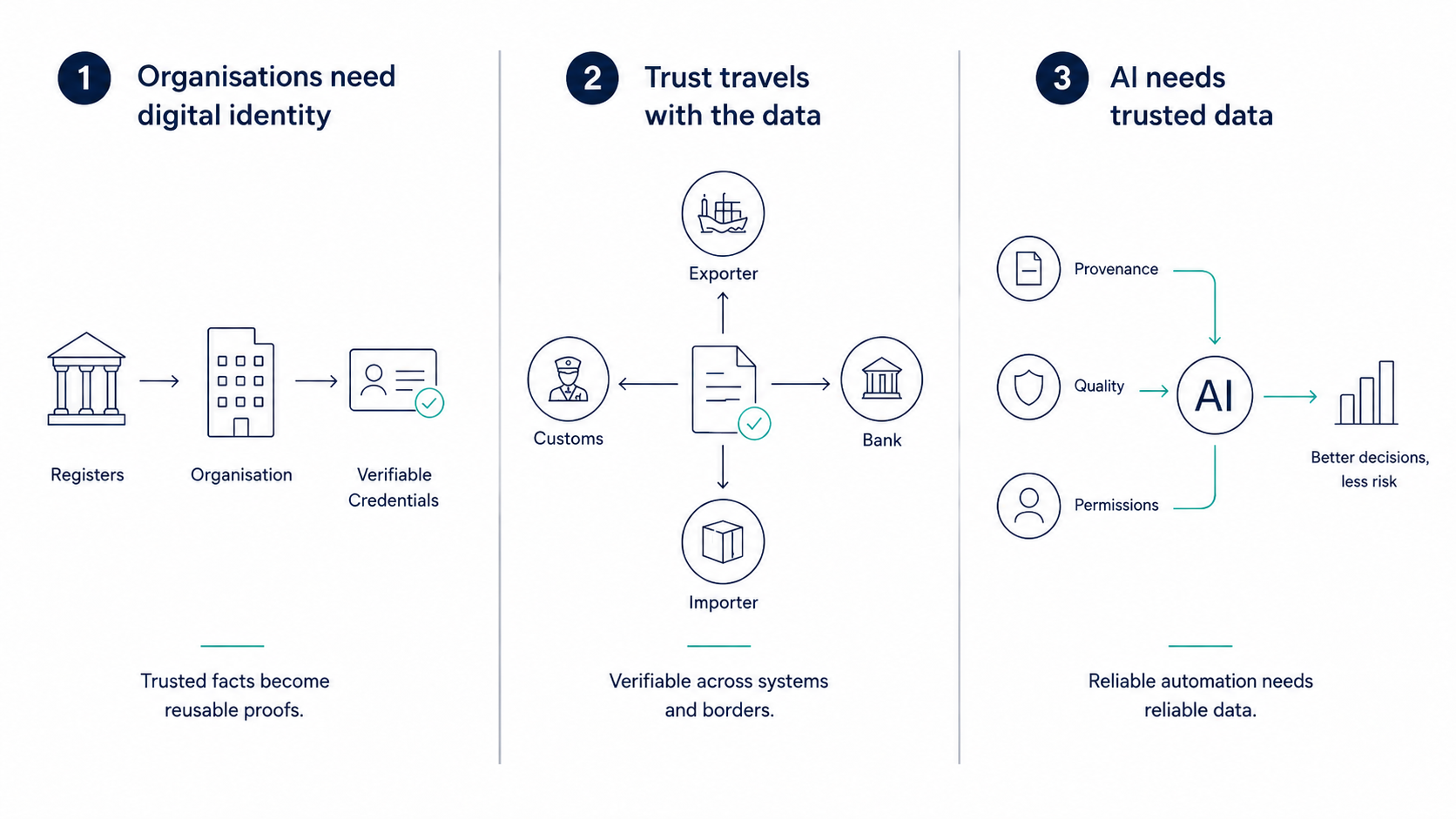
The Swiss E-ID discussion focuses mainly on individuals. That is necessary, but not sufficient. Many important digital interactions are done by organisations: companies, public bodies, hospitals, universities, associations, and the people or systems acting on their behalf. They need to prove who they are, who may represent them, and whether a specific statement or document can be trusted. Today, this is still often handled through register extracts, PDFs, signatures, portals and repeated checks. The information exists, but it is not easy to reuse or verify across systems. This is where organisational identity becomes important.
For this, GLEIF's (www.gleif.org) vLEI should be considered as one key relevant building block. It builds on the existing Legal Entity Identifier and makes organisational identity digitally verifiable. It can help prove not only that an organisation exists, but also who is authorised to act for it. For Switzerland, this matters because Swiss companies operate across borders. A purely national solution may help in domestic administration, but trade, finance, logistics and compliance need international recognition.
Registers remain the authoritative source. But facts from registers should become easier to use as verifiable credentials: company existence, legal form, licences, representation rights or other trusted claims. The goal is to make organisational claims verifiable when needed.
Trust has to travel with the data
Digital trade shows why this matters. Bills of lading, certificates, customs information, trade finance documents and compliance statements all depend on trust: trust in the organisation, the issuer, the representative and the data itself. Digitising documents is not enough. A PDF is not a trust infrastructure. A closed platform is not interoperability.
A better model is one where trust travels with the data. A receiving party should be able to verify who issued a claim, whether it was changed, whether it is still valid, and whether the organisation or person behind it had the authority to act. This also supports privacy and business confidentiality. Not every interaction requires full disclosure. Sometimes it is enough to prove a specific fact or threshold. In other cases, full information is required. A useful trust infrastructure should support these different levels of disclosure.
For Switzerland, this is also a question of practical digital sovereignty. Companies and public institutions should be able to act digitally, use global standards, avoid unnecessary platform dependency, and stay in control of critical trust relationships. The Swiss E-ID is an important foundation. But the larger opportunity is a trust infrastructure that also works for organisations and trusted data exchange.
That would make it more relevant for the real economy and more useful for Switzerland’s role in international digital trade.
AI increasingly needs trusted data, too
This also matters for automation. AI systems are only as useful as the data they can rely on. In business, trade and public administration, that means more than large data sets. It means knowing where data comes from, who is responsible for it, whether it is current, whether it may be used, and in which context it is valid.
Organisational identity and verifiable credentials can help make this explicit. They can link data to a company, a role, an issuer, a permission or a source. This makes data not only machine-readable, but more suitable for automated decision-making.
For Switzerland, this is important. We are unlikely to lead by building the largest AI models. But we can contribute by making high-quality, trusted and legally usable data easier to verify and reuse. That is a practical Swiss strength: trust, legal certainty, good governance and interoperability.

